

So, here we are in lockdown again.
No great surprises there, but what has shocked me is how different it feels this time around.
When we found ourselves housebound last spring I actually managed loads of lockdown achievements, from DIY projects around the house, to gardening, to brushing up on my Italian. This time, however, the kids and I are feeling decidedly more ‘meh’ about our corona captivity.
But, rather than succumbing to the blahs, I realised this was actually the perfect time for me and the 12-year-old to complete the Mindscreen confidence programme, which is specifically designed to improve your child’s self-esteem (and – in my case – teach your daughter to be a girl boss).

(Read more in my previous post about the Mindscreen programme and its founder, Gav Devereux).
Developed alongside psychologists, this is specifically for parents to complete about their child, and asks questions like: Do they seem demotivated and apathetic?’ Do they seem to have less interest in things they used to like? Do they seem to doubt themselves?
From there, you receive a report that identifies where your child is on the confidence scale, and whether or not they’d benefit from a course designed to improve your child’s self-esteem.
If you decide to move forward and purchase the full Mindscreen experience®, your child then completes their own evaluation.
The 12-year-old actually found it quite fun to work her way through the sets of questions, which presented her with a choice of descriptive words and asked her to rank them in order, from those most like her, to least.
She then finished by ranking a series of statements (I know my skills, I am confident, etc) from one to 10.
Not only did it make her really think about her likes and dislikes, it was an eye-opener for me too, to see how she viewed herself and her talents.
Next, a detailed Mindscreen experience® profile was prepared. I was actually blown away by how spot-on it was, from describing her personality traits, to highlighting careers that meshed well with her skills and interests.
The report alone was really insightful – some of the information I already knew, and other sections revealed some real ‘AHA!’ moments – connections I hadn’t made until I saw them written down in black & white.
Examples included:
• I like to frequently ask questions using the word ‘who’, for example, ‘Who’s going to be there? ‘Who wants to come with me?’
• I like to talk about things in an inspirational way and to be optimist about what I can achieve.
• I dislike it when people ‘box me in’ with too many rules.
Not only was it validating for her, it was also really useful for me to have this insight into her personality.
We’re quite different in the way we respond to situations; this helped me to understand she wasn’t necessarily trying to be awkward, she was simply reacting in her own individual way.
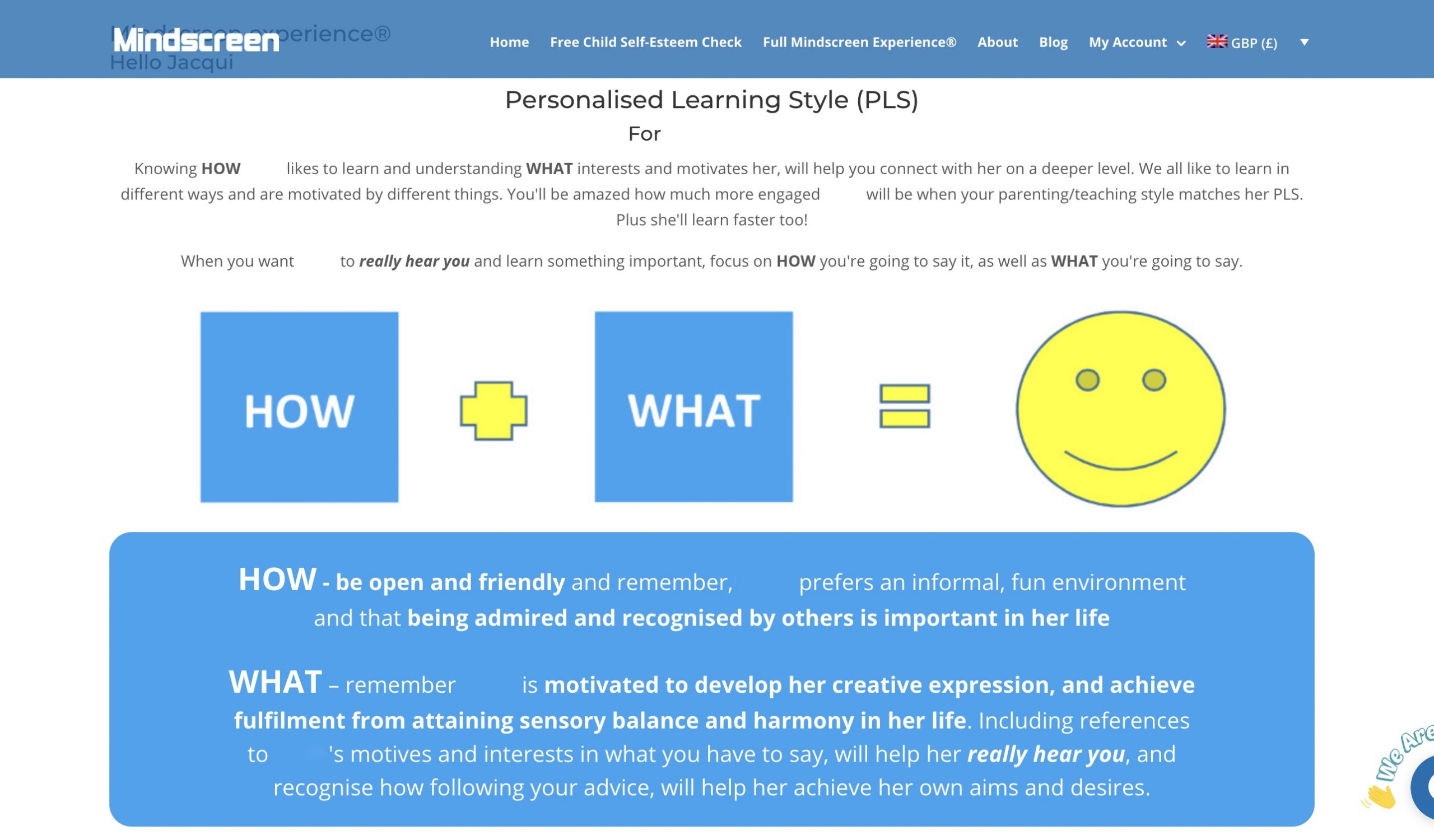
Alongside that was the 12-year-old’s Personalised Learning Style, ways to communicate with her that she’d really take in – ways to talk to her, not at her.
Our next step was to take the profile, and use it to help us work through the different Mindscreen experience® lesson plans, each of which dealt with a different fact of self-esteem building and future planning.
There were nine in total; we worked our way through Easy Awareness, Easy Belief, Easy Confidence, Easy Skills, Easy Study Choice, Easy Career Choice, Easy CV’s and Easy Future.
Many of the exercises called on us to discuss the results from the profile, digging deeper into the ‘what, where and why’ of the answers to really understand them and improve your child’s self-esteem.
I’d expected to have to drag the 12-year-old through some of the lessons, but she surprised me (and herself) by actually quite enjoying them. ‘It’s interesting to really think about what I’m good at, and find out about all the different jobs I could do,’ she explained.
Discussing her abilities out loud helped to solidify and make them more ‘real’ – something backed up when she saw me agreeing with what she was saying. There were also times when I was able to point out attributes she hadn’t considered for herself.
‘I think you’re very courageous,’ I told her. ‘You don’t allow fear to hold you back, and you’re always first in line to try something new – whether it’s a new food, or throwing yourself down a water slide.’
‘Hmmmmm…’ she conceded. ‘I guess I AM courageous.’
What struck me was how clever the lessons were. They didn’t tell your child anything new about themselves, rather they shone a light on their attributes and helped them to figure out how to use ALL their character traits – even ones they hadn’t viewed as positive.
Use your rebellious nature to your advantage, one of the 12-year-old’s Success Tips suggested. Choose to study in your own creative way. Decide what your study rules are; make an agreement with yourself to follow your own rules.
There were quite a few lightbulb moments along the way. The 12-year-old had been deflated to receive a lower than expected mark for one of her favourite subjects. Because it was a subject she really prided herself on, it had really dented her confidence.
After completing the Easy Future model – which looks at setting goals and not letting obstacles get in the way – she realised her class partner had been dragging her down by not taking the lessons seriously. She decided there and then that her dreams were too important to let anyone sabotage them, and vowed to switch partners as soon as they returned to school.
I loved the fact she’d put enough value on herself, and her future happiness, to make that decision.
The final module was Easy Feedback. For this, we went back over all the things she’d learned. We retook the Learning Improvement Graph exercise for the third and final time, and excitedly compared the progress she’d made. She’d improved her results in every category, except the one that asked: ‘What jobs/careers suit me?’
‘That’s because I thought I knew all the jobs I’d be good at,’ the 12-year-old explained. ‘But once I learned more about my strengths and skills, it made me realise there were lots more jobs I could do… I just hadn’t learned about them yet!’
The insight she now had into herself blew me away. Taking the Mindscreen experience® course didn’t just teach her to think about what she wanted from her life, it showed her there were so many doors out there, just waiting to be opened.
It shone a spotlight on all her positives, and gave her the tools to believe in herself and go after her dreams.
And I can’t wait to see what she does with it.
Flatlay image courtesy of Emma Matthews Digital Content Production; Unsplash
PIN ME!
Take the free Mindscreen online self-esteem test to find out if your child could also benefit from the confidence-building lessons.




I think this sounds really interesting!! My 12yo daughter is a funny one, in so many ways I feel she is really confident but then often lacking greatly in others. I have enjoyed having her at home during Covid because I feel like she has reverted to the girl that I know and love and not the one which senior school has created.
She would probably like something like this too, she wanted to have a go at a psychometric test the other day to get more insight into herself.
It was so interesting and really helpful for both of us, as it revealed lots of careers she could look into – many we hadn’t even considered before! She got really excited about some of them. Now we just have to get her back into school, haha!! xx